What is remote sensing??
Remote sensing is the science of obtaining information about objects or areas from a distance, typically from aircraft or satellites.
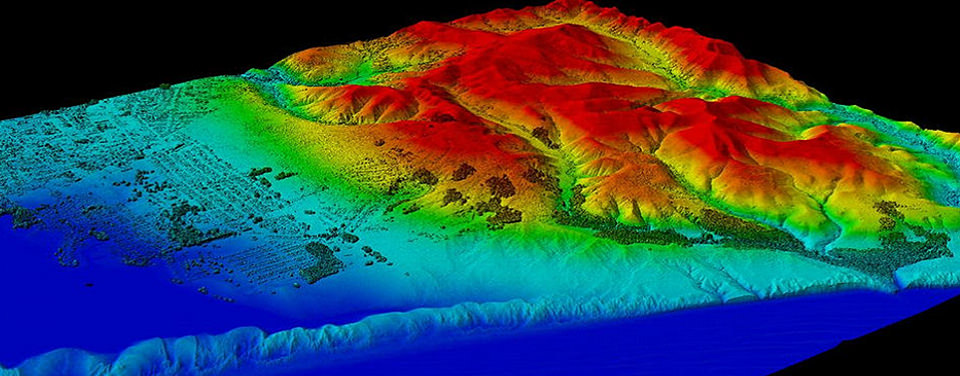


A LIDAR (Light Detection and Ranging) image created with data collected by NOAA's National Geodetic Survey.
Remote sensors collect data by detecting the energy that is reflected from Earth. These sensors can be on satellites or mounted on aircraft.
Remote sensors can be either passive or active. Passive sensors respond to external stimuli. They record natural energy that is reflected or emitted from the Earth's surface. The most common source of radiation detected by passive sensors is reflected sunlight.
In contrast, active sensors use internal stimuli to collect data about Earth. For example, a laser-beam remote sensing system projects a laser onto the surface of Earth and measures the time that it takes for the laser to reflect back to its sensor.
Remote sensing has a wide range of applications in many different fields:
- Coastal applications: Monitor shoreline changes, track sediment transport, and map coastal features. Data can be used for coastal mapping and erosion prevention.
- Ocean applications: Monitor ocean circulation and current systems, measure ocean temperature and wave heights, and track sea ice. Data can be used to better understand the oceans and how to best manage ocean resources.
- Hazard assessment: Track hurricanes, earthquakes, erosion, and flooding. Data can be used to assess the impacts of a natural disaster and create preparedness strategies to be used before and after a hazardous event.
- Natural resource management: Monitor land use, map wetlands, and chart wildlife habitats. Data can be used to minimize the damage that urban growth has on the environment and help decide how to best protect natural resources.
- Remote sensing related vedeo
- https://m.youtube.com/watch?v=YU9XphJqi6k&itct=CBMQpDAYASITCIi4u_KMrdcCFcEcaAodupgHbTIHcmVsYXRlZEj4ybOH9YfFxcQB
- Application of remote sensing
1. Determining soil moisture content using active and passive sensors from space
Soil moisture contributes so much to understanding Earth sciences… For example, it explains Earth’s water cycle, weather forecasting, drought and floods. But did you know there are two ways to derive soil moisture from space? First, it uses passive and active sensors .
Active sensors like Radarsat-2 illuminate their target and measures backscatter. In turn, this results in high spatial resolution but low accuracy. Second, passive sensors like SMOS measures naturally emitted microwave radiation. Unlike active sensors, it gives highly accurate but poor spatial resolution. How can we get the best of both worlds? This is what NASA’s Soil Moisture Active Passive (SMAP) Mission strives to achieve.
2. Mapping with laser precision using Light Detection and Ranging technology
If Dr. Evil was a geographer, LiDAR would be his weapon of choice. I can see it now, pinky in the mouth saying “bring out the laser“ . LiDAR measures the distance from the airborne platform to Earths surface using laser beams. This is how LiDAR got its name – “ Light Detection and Ranging”. What makes LiDAR so special is its densely sampled points at laser accuracy. LiDAR generates point clouds for digital surface models, digital elevation models and light intensity models.
3. Catching tax-evaders red-handed by locating new construction and building alterations
If you thought you could hide your home addition or swimming pool from your tax return without the city noticing… If you lived in Athens, Greece,
you’d be wrong. The tax revenue agency in Athens, Greece is looking for signs of wealth using satellite data. Not a bad idea where more than 15,000 swimming pools went unclaimed to tax authorities in 2010. The money-strapped country is looking at increasing their tax revenues using remote sensing applications using satellite imagery.
4. Spinning the globe with mapping services like Google Earth, Bing Maps and OpenStreetMaps
Who doesn’t like spinning the globe on Google Earth? Don’t lie. I know you do. Google Earth gives us an interface with updated satellite and aerial imagery at our fingertips for free. The convenience of knowing your location before you go with street view is mind-blowing. Who would’ve thought decades ago you could travel the world eating nachos in the comfort of your own home.
5. Predicting retail earnings and market share by counting cars in parking lot
Looking for remote sensing applications with a great return on investment? Investors find using satellite imagery at big box store parking lots gives the most bang for their buck. Companies like RS Metrics count the number of vehicles in parking lots. In turn, this gives a snapshot of earnings, conversion rates and market share. All things considered, it’s a simple high-tech strategy that can give market analysts the information needed.
6. Snapping aerial photos for military surveillance using messenger pigeons in World War II
Never trust a pigeon as your photographer. No matter what the occasion is, weddings, birthdays and times of war. Pigeons almost never follow their flight path and almost never return cameras to their owners. These were the hard lessons learned when the German military used the Bavarian Pigeon Corps to do their dirty work and spy on enemies.
7. Charging higher insurance premiums in flood-prone areas using radar
Ever notice your home insurance premium sky-rocket from the previous year? You
might have to thank a geographer for that. Some of the unique GIS and remote sensing applications that insurance companies use include radar and hydrological modelling. Geographers can map out areas more prone to flooding, how often these areas would flood and how badly the damage could be. In turn, this helps them better assess risk.
8. Doing the detective work for fraudulent crop insurance claims
As climate becomes less predictable and more destructive (such as droughts and floods), farmers have to adapt to this new reality. In this case, crop insurance can help farmers supplement their income when their fields don’t get seeded. But what happens when farmers commit crop insurance fraud? This is why insurance companies and the USGS have teamed up to investigate any wrong-doing. For example, the USGS measures vegetation growth using Landsat’s red, infrared channels in combination with NDVI . Using this information, crop insurance companies can verify seeded crops and catch fraud.
9. Searching for aircrafts and saving lives after fatal crashes
Of all remote sensing applications, there may be no other that touches the heart as much as saving another life through search and rescue. Hundreds of satellites orbit the Earth each day. Each one has its own live-saving ability – but only if it’s in the right time and place.
10. Detecting oil spills for marine life and environmental preservation
11.Oil spills have profound effects on marine life and the surrounding environment. An oil spill requires a quick response so the oil doesn’t disperse. Satellites can maximize the search for oil slicks. Not only can satellites determine the extent of the oil spills, they can identify the direction and rate of oil movement. This computer model uses current, ocean and weather forecasts, also obtained by remote sensing.ensure sustainable population levels
The sad story about the polar bear is that it is listed as one of the first animals that will become extinct because of global warming. Ecologists are turning to satellites as their primary source of information because they need a firm count on polar bears for their survival. So… How do you know the difference between a polar bear and a big white rock? In two images, polar bears moved, while rocks stayed in the same spot.
12. Uncovering habitat suitability and fragmentation for panda bears in protected areas
Giant pandas eat bamboo for 99% of their diet making them the ultimate bamboo-holic of the animal kingdom (think alcoholic but bamboo). Habitat is important for pandas. This makes roads and infrastructure ecological armageddon for pandas. Fragmentation and corridor mapping are remote sensing applications being used to protect the endangered panda.
13. Identifying forest stands and tallying their area to estimate forest supplies
Global forest supplies are being monitored because they not only provide valuable materials (think construction, paper, packaging…) but they also absorb roughly one-third of carbon dioxide emissions. AVHRR, MODIS and SPOT quantitatively measure the loss and gain of our global forests.
14. Navigating ships safely with the most optimal route
Imagine. The Titanic had GPS positioning and stirred clear from the iceberg. Hundreds of lives saved and husbands around the world could’ve avoided watching the Leo and Kate romance movie about it. But the harsh reality is that icebergs still threaten ships 100 years after the Titanic sunk. Ship navigation has improved. GPS is not the only ship navigation tool. Other remote sensing applications in ship navigation include routing analysis, wind and wave information and ship proximity.
15. Measuring wind speed and direction for wind farms, weather forecasting and surfers
Golfers, farmers, pilots, engineers and wind turbine planners need accurate wind information. Weather balloons and GPS are a good way to do this. But it’s not the only way. NASA’s QuickSCAT scatterometer and wind LiDAR are making these large-scale wind observations too.
16. Spying on enemies with reconnaissance satellites
Militaries are harnessing the power of satellite imagery to retrieve intelligence on enemies. As for remote sensing applications, reconnaissance satellites go all the way back to the 1950’s US Corona Program. Its purpose was to spy on the Soviet Union and China after the war. But satellites have come a long way from taking photographs and parachuting down to the surface. Now they’re so secretive that if they told you… well…
who knows what they would do to you
17. Delineating and assessing the health of riparian zones to conserve lakes and rivers
Riparian zones are the wooded areas along the water’s edge. They are the last line of environmental defense from nutrient runoff for our lakes and rivers. Of all remote sensing applications in environment, riparian zones perhaps require the highest spatial resolution because of its small width. A Landsat-8 pixel might not be able to do the job here. As water spans the entire globe, riparian zones are there too serving their duty.
18. Estimating surface elevation with the Shuttle Radar Topography Mission
Imagine you are a surveyor and your crew chief asks you to survey the whole world. You need to map 30 meter grid cells and are given only 11 days.
What would you say? I’d expect some profanity… This is essentially what NASA’s Shuttle Radar Topography Mission (SRTM) did in 11 days. The secret to its success is Interferometric Synthetic Aperture Radar. Learn more: Shuttle Radar Topography Mission: Interferometry Explained in More Detail
19. Extracting mineral deposits with hyperspectral remote sensing
There are over 4000 natural minerals on Earth. Each one has their own chemical composition. This is the equivalent to saying that each composition has its own spectral reflectance. Having more spectral bands like hyperspectral sensors gives potential to map more minerals. There is some predictability with remote sensing applications for geology and minerals. After spotting one mineral, almost certainly other specific minerals accompany it.
20. Watching algae grow as an indicator of environmental health
Watching algae grow is about
as much fun as watching paint dry. But you can learn a lot about a lake’s health by studying algae. It’s an indicator of the amount of nitrogen and phosphorous is being fed into the lake. Reducing nutrients is important because if affects local economies like fisheries and tourism. This is why NASA is using hyperspectral sensors to learn biochemical properties of algae blooms and even predict their locations. Learn more: NASA’s Lake Erie Project: Algae Growth
21water in satellite imagery increases with more suspended solids. But in order to monitor nutrient loading, there needs to be repeated coverage
1. Determining soil moisture content using active and passive sensors from space
Soil moisture contributes so much to understanding Earth sciences… For example, it explains Earth’s water cycle, weather forecasting, drought and floods. But did you know there are two ways to derive soil moisture from space? First, it uses passive and active sensors .
Active sensors like Radarsat-2 illuminate their target and measures backscatter. In turn, this results in high spatial resolution but low accuracy. Second, passive sensors like SMOS measures naturally emitted microwave radiation. Unlike active sensors, it gives highly accurate but poor spatial resolution. How can we get the best of both worlds? This is what NASA’s Soil Moisture Active Passive (SMAP) Mission strives to achieve.
2. Mapping with laser precision using Light Detection and Ranging technology
If Dr. Evil was a geographer, LiDAR would be his weapon of choice. I can see it now, pinky in the mouth saying “bring out the laser“ . LiDAR measures the distance from the airborne platform to Earths surface using laser beams. This is how LiDAR got its name – “ Light Detection and Ranging”. What makes LiDAR so special is its densely sampled points at laser accuracy. LiDAR generates point clouds for digital surface models, digital elevation models and light intensity models.
3. Catching tax-evaders red-handed by locating new construction and building alterations
If you thought you could hide your home addition or swimming pool from your tax return without the city noticing… If you lived in Athens, Greece,
you’d be wrong. The tax revenue agency in Athens, Greece is looking for signs of wealth using satellite data. Not a bad idea where more than 15,000 swimming pools went unclaimed to tax authorities in 2010. The money-strapped country is looking at increasing their tax revenues using remote sensing applications using satellite imagery.
4. Spinning the globe with mapping services like Google Earth, Bing Maps and OpenStreetMaps
Who doesn’t like spinning the globe on Google Earth? Don’t lie. I know you do. Google Earth gives us an interface with updated satellite and aerial imagery at our fingertips for free. The convenience of knowing your location before you go with street view is mind-blowing. Who would’ve thought decades ago you could travel the world eating nachos in the comfort of your own home.
5. Predicting retail earnings and market share by counting cars in parking lot
Looking for remote sensing applications with a great return on investment? Investors find using satellite imagery at big box store parking lots gives the most bang for their buck. Companies like RS Metrics count the number of vehicles in parking lots. In turn, this gives a snapshot of earnings, conversion rates and market share. All things considered, it’s a simple high-tech strategy that can give market analysts the information needed.
6. Snapping aerial photos for military surveillance using messenger pigeons in World War II
Never trust a pigeon as your photographer. No matter what the occasion is, weddings, birthdays and times of war. Pigeons almost never follow their flight path and almost never return cameras to their owners. These were the hard lessons learned when the German military used the Bavarian Pigeon Corps to do their dirty work and spy on enemies.
7. Charging higher insurance premiums in flood-prone areas using radar
Ever notice your home insurance premium sky-rocket from the previous year? You
might have to thank a geographer for that. Some of the unique GIS and remote sensing applications that insurance companies use include radar and hydrological modelling. Geographers can map out areas more prone to flooding, how often these areas would flood and how badly the damage could be. In turn, this helps them better assess risk.
8. Doing the detective work for fraudulent crop insurance claims
As climate becomes less predictable and more destructive (such as droughts and floods), farmers have to adapt to this new reality. In this case, crop insurance can help farmers supplement their income when their fields don’t get seeded. But what happens when farmers commit crop insurance fraud? This is why insurance companies and the USGS have teamed up to investigate any wrong-doing. For example, the USGS measures vegetation growth using Landsat’s red, infrared channels in combination with NDVI . Using this information, crop insurance companies can verify seeded crops and catch fraud.
9. Searching for aircrafts and saving lives after fatal crashes
Of all remote sensing applications, there may be no other that touches the heart as much as saving another life through search and rescue. Hundreds of satellites orbit the Earth each day. Each one has its own live-saving ability – but only if it’s in the right time and place.
10. Detecting oil spills for marine life and environmental preservation
11.Oil spills have profound effects on marine life and the surrounding environment. An oil spill requires a quick response so the oil doesn’t disperse. Satellites can maximize the search for oil slicks. Not only can satellites determine the extent of the oil spills, they can identify the direction and rate of oil movement. This computer model uses current, ocean and weather forecasts, also obtained by remote sensing.ensure sustainable population levels
The sad story about the polar bear is that it is listed as one of the first animals that will become extinct because of global warming. Ecologists are turning to satellites as their primary source of information because they need a firm count on polar bears for their survival. So… How do you know the difference between a polar bear and a big white rock? In two images, polar bears moved, while rocks stayed in the same spot.
12. Uncovering habitat suitability and fragmentation for panda bears in protected areas
Giant pandas eat bamboo for 99% of their diet making them the ultimate bamboo-holic of the animal kingdom (think alcoholic but bamboo). Habitat is important for pandas. This makes roads and infrastructure ecological armageddon for pandas. Fragmentation and corridor mapping are remote sensing applications being used to protect the endangered panda.
13. Identifying forest stands and tallying their area to estimate forest supplies
Global forest supplies are being monitored because they not only provide valuable materials (think construction, paper, packaging…) but they also absorb roughly one-third of carbon dioxide emissions. AVHRR, MODIS and SPOT quantitatively measure the loss and gain of our global forests.
14. Navigating ships safely with the most optimal route
Imagine. The Titanic had GPS positioning and stirred clear from the iceberg. Hundreds of lives saved and husbands around the world could’ve avoided watching the Leo and Kate romance movie about it. But the harsh reality is that icebergs still threaten ships 100 years after the Titanic sunk. Ship navigation has improved. GPS is not the only ship navigation tool. Other remote sensing applications in ship navigation include routing analysis, wind and wave information and ship proximity.
15. Measuring wind speed and direction for wind farms, weather forecasting and surfers
Golfers, farmers, pilots, engineers and wind turbine planners need accurate wind information. Weather balloons and GPS are a good way to do this. But it’s not the only way. NASA’s QuickSCAT scatterometer and wind LiDAR are making these large-scale wind observations too.
16. Spying on enemies with reconnaissance satellites
Militaries are harnessing the power of satellite imagery to retrieve intelligence on enemies. As for remote sensing applications, reconnaissance satellites go all the way back to the 1950’s US Corona Program. Its purpose was to spy on the Soviet Union and China after the war. But satellites have come a long way from taking photographs and parachuting down to the surface. Now they’re so secretive that if they told you… well…
who knows what they would do to you
17. Delineating and assessing the health of riparian zones to conserve lakes and rivers
Riparian zones are the wooded areas along the water’s edge. They are the last line of environmental defense from nutrient runoff for our lakes and rivers. Of all remote sensing applications in environment, riparian zones perhaps require the highest spatial resolution because of its small width. A Landsat-8 pixel might not be able to do the job here. As water spans the entire globe, riparian zones are there too serving their duty.
18. Estimating surface elevation with the Shuttle Radar Topography Mission
Imagine you are a surveyor and your crew chief asks you to survey the whole world. You need to map 30 meter grid cells and are given only 11 days.
What would you say? I’d expect some profanity… This is essentially what NASA’s Shuttle Radar Topography Mission (SRTM) did in 11 days. The secret to its success is Interferometric Synthetic Aperture Radar. Learn more: Shuttle Radar Topography Mission: Interferometry Explained in More Detail
19. Extracting mineral deposits with hyperspectral remote sensing
There are over 4000 natural minerals on Earth. Each one has their own chemical composition. This is the equivalent to saying that each composition has its own spectral reflectance. Having more spectral bands like hyperspectral sensors gives potential to map more minerals. There is some predictability with remote sensing applications for geology and minerals. After spotting one mineral, almost certainly other specific minerals accompany it.
20. Watching algae grow as an indicator of environmental health
Watching algae grow is about
as much fun as watching paint dry. But you can learn a lot about a lake’s health by studying algae. It’s an indicator of the amount of nitrogen and phosphorous is being fed into the lake. Reducing nutrients is important because if affects local economies like fisheries and tourism. This is why NASA is using hyperspectral sensors to learn biochemical properties of algae blooms and even predict their locations. Learn more: NASA’s Lake Erie Project: Algae Growth
21water in satellite imagery increases with more suspended solids. But in order to monitor nutrient loading, there needs to be repeated coverage


Comments
Post a Comment